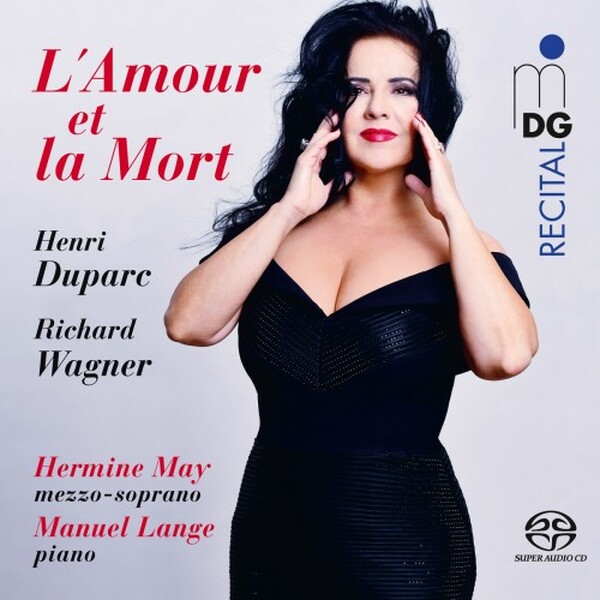
L’Amour et la Mort: Works by Duparc & Wagner
£14.73
Despatch Information
This despatch estimate is based on information from both our own stock and the UK supplier's stock.
If ordering multiple items, we will aim to send everything together so the longest despatch estimate will apply to the complete order.
If you would rather receive certain items more quickly, please place them on a separate order.
If any unexpected delays occur, we will keep you informed of progress via email and not allow other items on the order to be held up.
If you would prefer to receive everything together regardless of any delay, please let us know via email.
Pre-orders will be despatched as close as possible to the release date.
Label: MDG (Dabringhaus und Grimm)
Cat No: MDG90823786
Format: Hybrid SACD
Number of Discs: 1
Genre: Vocal/Choral
Expected Release Date: 23rd January 2026
Contents
Works
Chanson tristeElegie
Extase
L'Invitation au voyage
La Vie anterieure
Le Manoir de Rosamonde
Phidyle
Soupir
Testament
Tristan und Isolde
Artists
Hermine May (mezzo-soprano)Manuel Lange (piano)
Works
Chanson tristeElegie
Extase
L'Invitation au voyage
La Vie anterieure
Le Manoir de Rosamonde
Phidyle
Soupir
Testament
Tristan und Isolde
Artists
Hermine May (mezzo-soprano)Manuel Lange (piano)
About
The Wesendonck Lieder build a musical bridge to the opera, with Im Treibhaus and Träume described by Wagner himself as "studies for Tristan". Isoldes Liebestod is an emotionally charged, virtuosic piano version, arranged by Wagner’s friend and father-in-law Franz Liszt, which is combined here with Wagner’s original vocal part for Isolde.
Henri Duparc’s chansons in L’amour et la mort narrate the stages of Tristan’s love from dreamy longing, through forbidden lustful fulfilment, to Isolde’s fatal ecstasy in an impressionistic tonal language that repeatedly revolves around Tristan motifs and variations of its famous chord.
Hardly any other French composer was as greatly influenced by the Bayreuth master as Duparc. The rampant wagnérisme in Paris in the second half of the nineteenth century had enraptured him, especially the love-death mysticism of Tristan and Isolde. His famous mélodies, even though only 17 of his songs have survived, are such jewels of musical prosody that Duparc became known as one of the most important French song composers.
Error on this page? Let us know here
Need more information on this product? Click here